 Add to Chrome
 Add to Firefox
 Add to Edge
DFlare: Scaling Up Draft Capacity for Block Diffusion Speculative Decoding
Jun 01, 2026
Block diffusion speculative decoding accelerates LLM inference by predicting all tokens within a block simultaneously for the target model to verify in parallel. Predicting an entire block at once requires a sufficiently capable draft model and effective utilization of the target model's internal knowledge. However, the state-of-the-art method DFlash constrains all draft layers to share a single fused representation derived from only a few target layers, limiting per-layer expressiveness and hindering further scaling of draft capacity. In this paper, we present \modelname, which flares out the narrow conditioning bottleneck of DFlash through a lightweight layer-wise fusion mechanism: each draft layer attends to its own learnable combination of a broad set of target layers at negligible overhead, simultaneously injecting richer target knowledge and providing every draft layer with a distinct input. This enhanced per-layer expressiveness enables scaling the draft model to deeper architectures with consistent gains. We further scale training data from 800K to 2.4M samples to fully exploit the enlarged capacity. On six benchmarks spanning mathematical reasoning, code generation, and conversation, \modelname attains average wall-clock speedups of 5.52x on Qwen3-4B, 5.46x on Qwen3-8B, and 3.91x on GPT-OSS-20B, improving over DFlash by roughly 11\%, 8\%, and 5\% respectively. Our code is available at https://github.com/Tencent/AngelSlim.

What Does LLM Refinement Actually Improve? A Systematic Study on Document-Level Literary Translation
May 13, 2026Iterative self-refinement is a simple inference-time strategy for machine translation: an LLM revises its own translation over multiple inference-time passes. Yet document-scale refinement remains poorly understood: 1) which pipelines work best, 2) what quality dimensions improve, and 3) how refiners behave. In this paper, we present a systematic study of document-level literary translation, covering nine LLMs and seven language pairs. Across nine translation-refinement granularity combinations and five refinement strategies, we find a robust recipe: document-level MT followed by segment-level refinement yields strong and stable improvements. In contrast, document-level refinement often makes fewer edits and leads to smaller or less reliable gains. Beyond granularity, A simple general refinement prompt consistently outperforms error-specific prompting and evaluate-then-refine schemes. Our large-scale human evaluation shows that refinement gains come primarily from fluency, style, and terminology, with limited and less consistent improvements in adequacy. Experiments varying model strength reveal refinement projects outputs toward the refiner's distribution rather than performing targeted error repair. These findings clarify the mechanisms and limitations of current refinement approaches.
Learning to Draft: Adaptive Speculative Decoding with Reinforcement Learning
Mar 02, 2026Speculative decoding accelerates large language model (LLM) inference by using a small draft model to generate candidate tokens for a larger target model to verify. The efficacy of this technique hinges on the trade-off between the time spent on drafting candidates and verifying them. However, current state-of-the-art methods rely on a static time allocation, while recent dynamic approaches optimize for proxy metrics like acceptance length, often neglecting the true time cost and treating the drafting and verification phases in isolation. To address these limitations, we introduce Learning to Draft (LTD), a novel method that directly optimizes for throughput of each draft-and-verify cycle. We formulate the problem as a reinforcement learning environment and train two co-adaptive policies to dynamically coordinate the draft and verification phases. This encourages the policies to adapt to each other and explicitly maximize decoding efficiency. We conducted extensive evaluations on five diverse LLMs and four distinct tasks. Our results show that LTD achieves speedup ratios ranging from 2.24x to 4.32x, outperforming the state-of-the-art method Eagle3 up to 36.4%.
PaperBanana: Automating Academic Illustration for AI Scientists
Jan 30, 2026Despite rapid advances in autonomous AI scientists powered by language models, generating publication-ready illustrations remains a labor-intensive bottleneck in the research workflow. To lift this burden, we introduce PaperBanana, an agentic framework for automated generation of publication-ready academic illustrations. Powered by state-of-the-art VLMs and image generation models, PaperBanana orchestrates specialized agents to retrieve references, plan content and style, render images, and iteratively refine via self-critique. To rigorously evaluate our framework, we introduce PaperBananaBench, comprising 292 test cases for methodology diagrams curated from NeurIPS 2025 publications, covering diverse research domains and illustration styles. Comprehensive experiments demonstrate that PaperBanana consistently outperforms leading baselines in faithfulness, conciseness, readability, and aesthetics. We further show that our method effectively extends to the generation of high-quality statistical plots. Collectively, PaperBanana paves the way for the automated generation of publication-ready illustrations.
SonicBench: Dissecting the Physical Perception Bottleneck in Large Audio Language Models
Jan 16, 2026Large Audio Language Models (LALMs) excel at semantic and paralinguistic tasks, yet their ability to perceive the fundamental physical attributes of audio such as pitch, loudness, and spatial location remains under-explored. To bridge this gap, we introduce SonicBench, a psychophysically grounded benchmark that systematically evaluates 12 core physical attributes across five perceptual dimensions. Unlike previous datasets, SonicBench uses a controllable generation toolbox to construct stimuli for two complementary paradigms: recognition (absolute judgment) and comparison (relative judgment). This design allows us to probe not only sensory precision but also relational reasoning capabilities, a domain where humans typically exhibit greater proficiency. Our evaluation reveals a substantial deficiency in LALMs' foundational auditory understanding; most models perform near random guessing and, contrary to human patterns, fail to show the expected advantage on comparison tasks. Furthermore, explicit reasoning yields minimal gains. However, our linear probing analysis demonstrates crucially that frozen audio encoders do successfully capture these physical cues (accuracy at least 60%), suggesting that the primary bottleneck lies in the alignment and decoding stages, where models fail to leverage the sensory signals they have already captured.
MiMo-V2-Flash Technical Report
Jan 08, 2026We present MiMo-V2-Flash, a Mixture-of-Experts (MoE) model with 309B total parameters and 15B active parameters, designed for fast, strong reasoning and agentic capabilities. MiMo-V2-Flash adopts a hybrid attention architecture that interleaves Sliding Window Attention (SWA) with global attention, with a 128-token sliding window under a 5:1 hybrid ratio. The model is pre-trained on 27 trillion tokens with Multi-Token Prediction (MTP), employing a native 32k context length and subsequently extended to 256k. To efficiently scale post-training compute, MiMo-V2-Flash introduces a novel Multi-Teacher On-Policy Distillation (MOPD) paradigm. In this framework, domain-specialized teachers (e.g., trained via large-scale reinforcement learning) provide dense and token-level reward, enabling the student model to perfectly master teacher expertise. MiMo-V2-Flash rivals top-tier open-weight models such as DeepSeek-V3.2 and Kimi-K2, despite using only 1/2 and 1/3 of their total parameters, respectively. During inference, by repurposing MTP as a draft model for speculative decoding, MiMo-V2-Flash achieves up to 3.6 acceptance length and 2.6x decoding speedup with three MTP layers. We open-source both the model weights and the three-layer MTP weights to foster open research and community collaboration.
MiMo-Audio: Audio Language Models are Few-Shot Learners
Dec 29, 2025Existing audio language models typically rely on task-specific fine-tuning to accomplish particular audio tasks. In contrast, humans are able to generalize to new audio tasks with only a few examples or simple instructions. GPT-3 has shown that scaling next-token prediction pretraining enables strong generalization capabilities in text, and we believe this paradigm is equally applicable to the audio domain. By scaling MiMo-Audio's pretraining data to over one hundred million of hours, we observe the emergence of few-shot learning capabilities across a diverse set of audio tasks. We develop a systematic evaluation of these capabilities and find that MiMo-Audio-7B-Base achieves SOTA performance on both speech intelligence and audio understanding benchmarks among open-source models. Beyond standard metrics, MiMo-Audio-7B-Base generalizes to tasks absent from its training data, such as voice conversion, style transfer, and speech editing. MiMo-Audio-7B-Base also demonstrates powerful speech continuation capabilities, capable of generating highly realistic talk shows, recitations, livestreaming and debates. At the post-training stage, we curate a diverse instruction-tuning corpus and introduce thinking mechanisms into both audio understanding and generation. MiMo-Audio-7B-Instruct achieves open-source SOTA on audio understanding benchmarks (MMSU, MMAU, MMAR, MMAU-Pro), spoken dialogue benchmarks (Big Bench Audio, MultiChallenge Audio) and instruct-TTS evaluations, approaching or surpassing closed-source models. Model checkpoints and full evaluation suite are available at https://github.com/XiaomiMiMo/MiMo-Audio.
DocLens : A Tool-Augmented Multi-Agent Framework for Long Visual Document Understanding
Nov 14, 2025Comprehending long visual documents, where information is distributed across extensive pages of text and visual elements, is a critical but challenging task for modern Vision-Language Models (VLMs). Existing approaches falter on a fundamental challenge: evidence localization. They struggle to retrieve relevant pages and overlook fine-grained details within visual elements, leading to limited performance and model hallucination. To address this, we propose DocLens, a tool-augmented multi-agent framework that effectively ``zooms in'' on evidence like a lens. It first navigates from the full document to specific visual elements on relevant pages, then employs a sampling-adjudication mechanism to generate a single, reliable answer. Paired with Gemini-2.5-Pro, DocLens achieves state-of-the-art performance on MMLongBench-Doc and FinRAGBench-V, surpassing even human experts. The framework's superiority is particularly evident on vision-centric and unanswerable queries, demonstrating the power of its enhanced localization capabilities.
PricingLogic: Evaluating LLMs Reasoning on Complex Tourism Pricing Tasks
Oct 14, 2025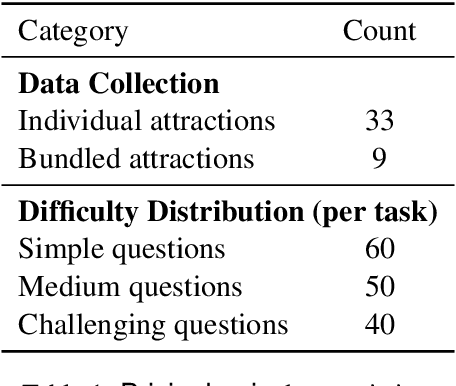
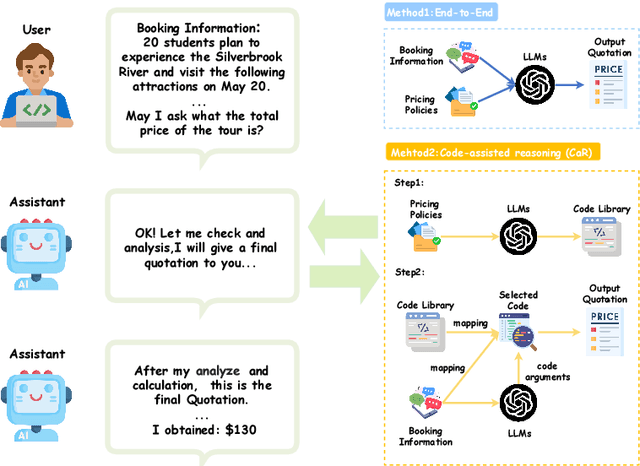
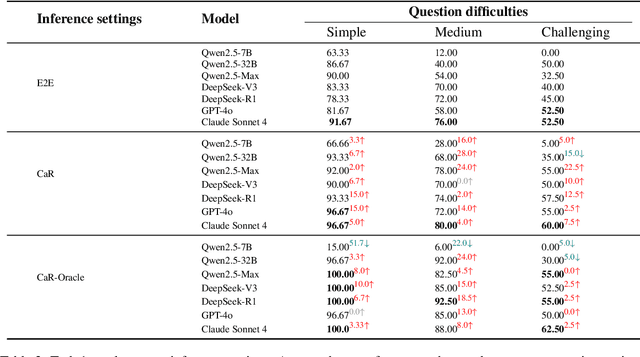
We present PricingLogic, the first benchmark that probes whether Large Language Models(LLMs) can reliably automate tourism-related prices when multiple, overlapping fare rules apply. Travel agencies are eager to offload this error-prone task onto AI systems; however, deploying LLMs without verified reliability could result in significant financial losses and erode customer trust. PricingLogic comprises 300 natural-language questions based on booking requests derived from 42 real-world pricing policies, spanning two levels of difficulty: (i) basic customer-type pricing and (ii)bundled-tour calculations involving interacting discounts. Evaluations of a line of LLMs reveal a steep performance drop on the harder tier,exposing systematic failures in rule interpretation and arithmetic reasoning.These results highlight that, despite their general capabilities, today's LLMs remain unreliable in revenue-critical applications without further safeguards or domain adaptation. Our code and dataset are available at https://github.com/EIT-NLP/PricingLogic.
MultiJustice: A Chinese Dataset for Multi-Party, Multi-Charge Legal Prediction
Jul 09, 2025Legal judgment prediction offers a compelling method to aid legal practitioners and researchers. However, the research question remains relatively under-explored: Should multiple defendants and charges be treated separately in LJP? To address this, we introduce a new dataset namely multi-person multi-charge prediction (MPMCP), and seek the answer by evaluating the performance of several prevailing legal large language models (LLMs) on four practical legal judgment scenarios: (S1) single defendant with a single charge, (S2) single defendant with multiple charges, (S3) multiple defendants with a single charge, and (S4) multiple defendants with multiple charges. We evaluate the dataset across two LJP tasks, i.e., charge prediction and penalty term prediction. We have conducted extensive experiments and found that the scenario involving multiple defendants and multiple charges (S4) poses the greatest challenges, followed by S2, S3, and S1. The impact varies significantly depending on the model. For example, in S4 compared to S1, InternLM2 achieves approximately 4.5% lower F1-score and 2.8% higher LogD, while Lawformer demonstrates around 19.7% lower F1-score and 19.0% higher LogD. Our dataset and code are available at https://github.com/lololo-xiao/MultiJustice-MPMCP.